
Automate your job, not your gym

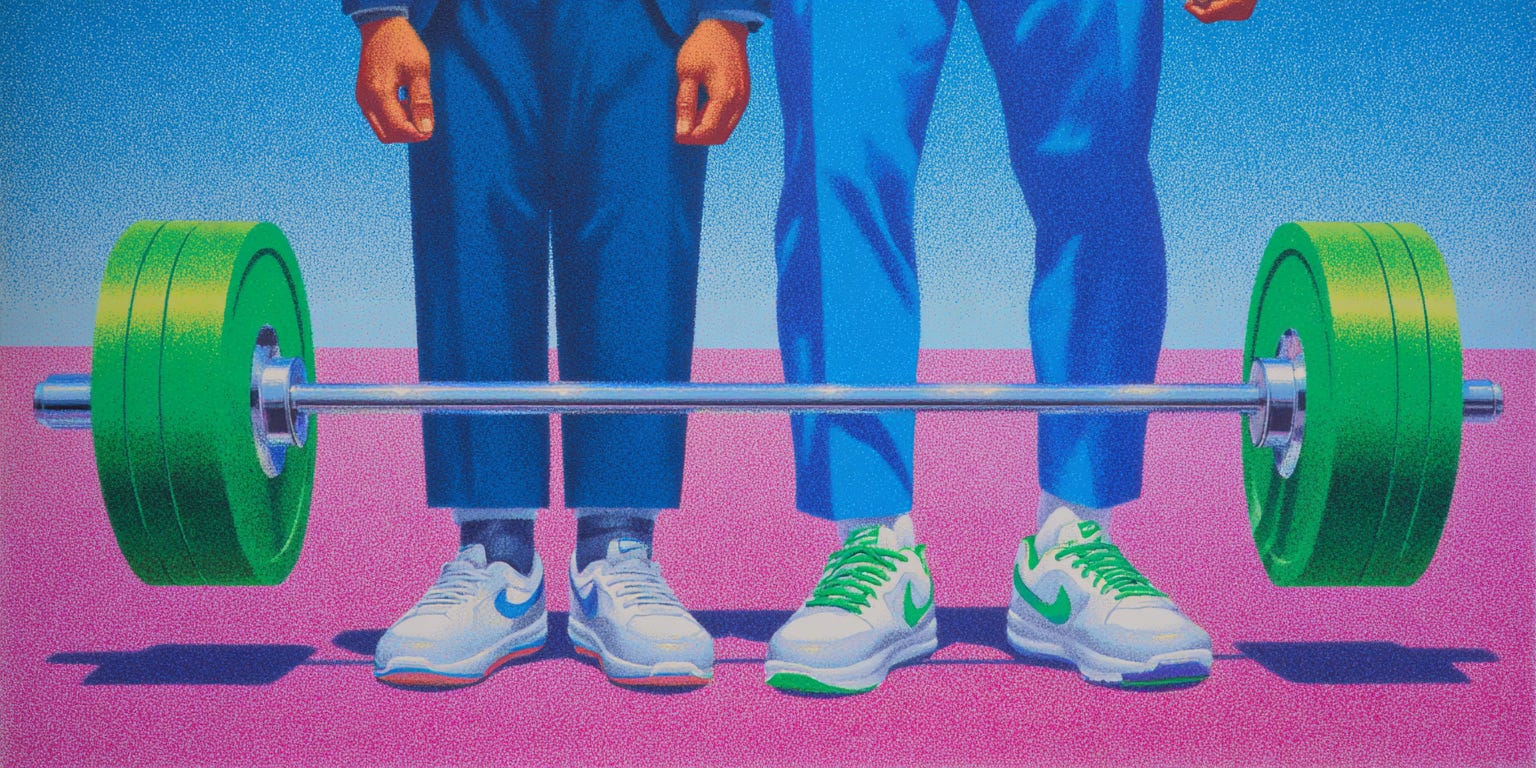
K is a strange shape for a graph - any other letter-inspired trend moves the population in one direction. K, used to describe the economy recovery post COVID, shows that there are now two populations moving in opposite directions, and from now on, their experiences of the same events will have nothing in common. The evolution of thinking will follow a K-shaped pattern, too, but not along the lines we think.
Imagine you go to the gym, pick up the weights, and someone taps you on the shoulder and says: we have this new equipment that will do the work for you; it will do it faster and longer, whatever weight and move you want.
Obviously, you’d say no - that’s not why you’re at the gym, you’re there for the benefits that come from having done the lifting yourself. But outside of the gym, there are heavy things that just need to be lifted, like at a job. You’d say yes; whether you do the work yourself doesn’t matter, it just needs to be done.
Somehow, this mental shortcut is overlooked when it comes to AI. There are the Optimizers, beating the drum to the tune du jour, oblivious to the poor passerby doing their best to drown out the innovation of shaving off 3 minutes from their tasks, or the latest update on how their jobs will be obliterated. Somehow, the way the Optimizers advocate for the technology makes it even less appetizing than the issues the Critics are raising. Everything should be automated.
And Critics have a lot to criticize. The water issue, the power grid, copyright, the impact of AI on the arts, brains, education, employment; concerns that the Optimizers find frustratingly valid, if exaggerated. Their opposition to AI is undiluted, grievances typed on smartphones that required 3,000 gallons of water to assemble, uploaded to data centers that drink 5,000,000 gallons of water per day. Not only do they stay away from AI chatbots or otherwise, but actively abandon any tool that has the audacity to smuggle AI into its legacy features. “Using AI is sloppy, lazy, cheating, disrespectful” they say, “to surrender is to die while you’re still breathing and walking around.” Nothing should be delegated.
I wonder if the most unsettling thought for both is the realization that we’ve weaved our identities out of something that might have an expiration date on its relevance.
For the rest of us sitting somewhere in between, there’s the job vs. gym analogy, which asks: which of the cognitive tasks am I trying to get better at over time, and which ones do I just need done?
You don’t have to be a purist (and you would be missing an opportunity if you were); you just need to decide what’s the way to use AI to upgrade your thinking engine instead of replacing it. Delegating the task end-to-end obviously isn’t it. A student trying to bang out an essay before the deadline is at a job, even though their professor passionately argues they are, in fact, at a gym.
Po-Shen Loh sees it first-hand, showing up in schools across the world, with a talk: “How to survive the ChatGPT invasion?”. He is a math olympiad coach turned inspirational speaker well-suited for the moment where most of us look for a mental vaccine that’ll make us immune to being displaced. I imagine him standing in front of the trepidatious crowd of students waiting to alleviate their fears. Until I realize they’re most likely rolling their eyes; the concern, and the invitation to speak, actually their parents’, not their own. Po-Shen Loh’s goal is to help students find the friction of their own thinking.
The alternative sucks. MIT study showed that brains slowly turn off when we delegate thinking to AI: over time (like, three sessions. not years) half the EEG lights go dim. Delegate thinking, and before you know it, the brain atrophies, and crawling out of the cognitive hole is even harder than not falling into it in the first place. Without the friction of trying to carve out something from our own unripe thoughts, something goes vacant.
Po-Shen’s crowd and the poor suckers from the ChatGPT group in the MIT study show the two diverging populations of the K shape: a person sitting in a lab, electrodes on their scalp, writing something they won’t remember writing, the decline not felt but seen on the monitors; and a student grinding through an obscure math problem purely to learn how to solve problems. Po-Shen is clear that you don’t need to shun AI - just use it in a way that compounds your thinking skill upwards. Delegating shifts them downwards. K-shaped economy showed that the exact same environment can bring about different results to different populations, and the same thing will happen with AI and cognition. We have seen this before with our approach to… food.
In the MIT research, one participant admits they “went back to using ChatGPT because I didn’t have enough time, but I feel guilty about it”, someone else echoed that it “feels like cheating”. Maybe on a personal level, then, the distinction between being on the diverging arms of the “K” is not that difficult to spot.
Thank you to Shafkat Rahman for pointing me to the MIT paper and Po-Shen Loh’s work.